Physics

Physics A Level is an exciting theoretical and practically-based problem-solving subject which at its core looks at how the world works, from the constituent parts of atoms to the evolution of the universe.


Course content:

Year 12

In this first year students will start to develop practical skills (including planning, implementing, analysis and evaluation) and work on the foundations of physics (including physical quantities and units, making measurements, analysing data and the nature of quantities). Students’ study will build on previous knowledge about forces and motion (including forces in action, work, energy, power, materials, Newton’s laws of motion and momentum). More challenging concepts are explored such as electrons, waves, and photons (including charge and current, energy, power, resistance, electrical circuits, waves and quantum physics).


Year 13

Students will start to engage with more complex ideas, the Newtonian world and astrophysics (thermal physics, circular motion, oscillations, gravitational fields and astrophysics). Finally, the course finishes by reviewing some of the most thought-provoking concepts such as particle and medical physics (including capacitors, electric fields, electromagnetism, nuclear and particle physics and medical imaging).


Assessment criteria:

Three written exam papers are taken at the end of the two-year course and a Practical Endorsement award based on the student’s competency in the laboratory setting.


Intent: The first year of OCR A-Level Physics develops students’ understanding of fundamental physical principles while building the practical, mathematical and analytical skills required for advanced study. Through the units of study students establish a secure foundation in both theoretical and experimental physics.

The practical endorsement develops practical and investigative skills, enabling students to plan experiments, analyse data, evaluate evidence and communicate scientific conclusions effectively. Students study forces, motion, energy, materials and momentum, applying mathematical models to explain and predict physical behaviour. In the second topic the focus is on electrons, waves and photons, introducing students to electric circuits, wave phenomena, optics and quantum physics.

Throughout the course, students are encouraged to think critically, solve problems and communicate scientific ideas accurately using appropriate terminology and mathematical techniques. By the end of Year 1, students will have developed a coherent understanding of core concepts and practical skills, providing a strong foundation for the second year of the course and future scientific study.


Term 1

Foundations in Physics

Forces & Motion

Materials & Conservation Laws

Knowledge:

Students develop a secure understanding of core physics across mechanics and materials. In mechanics, this includes scalar and vector quantities, kinematics equations of motion, Newton’s laws of motion, resolving forces, moments, equilibrium, momentum and impulse, and circular motion. Students also study work, energy and power, including energy transfer, efficiency and conservation principles.

In materials, learners explore density, stress, strain and Young modulus, linking microscopic structure to macroscopic behaviour such as elastic deformation and plasticity.

Across these topics, students apply mathematical relationships to model physical systems, interpret graphs, and solve multi-step problems. They develop understanding of how these principles explain real-world systems such as collisions, structural loading, vehicle motion and material behaviour under force.

This knowledge base provides the foundation for further study in fields such as fields, waves, quantum physics and advanced mechanics in later modules.

Skills:

Students develop core practical and investigative skills, including planning and refining experiments, selecting appropriate apparatus, and working safely and accurately. They learn to collect reliable data, identify uncertainties, and apply statistical methods to improve validity. Students also build competence in data analysis, including graphing, interpreting gradients and areas, and using mathematical relationships to model physical systems. Communication skills are developed through clear presentation of results and scientific reasoning, alongside the ability to critically evaluate experimental methods and outcomes.


Useful Links

Cambridge OCR Level 3 Advanced Level in Physics A Specification (H556)

OCR (A) Physics Revision – Physics & Maths Tutor

OCR A | A Level Physics

Science Shorts – YouTube


Assessments:

End of topic exam style question assessments

Isaac Physics online learning platform

Practical Endorsement assessed practical investigations

November Preparatory examinations


Term 2

Electricity & Circuits

Waves & Quantum Physics

Knowledge:

Students gain a detailed understanding of wave properties including superposition, diffraction, interference, refraction and polarisation, alongside the full electromagnetic spectrum and its applications. In electricity, they study charge, current, potential difference, resistance, Ohm’s law, I–V characteristics, emf and internal resistance, and how energy is transferred in circuits. In quantum physics, students explore the photon model of light, the photoelectric effect, energy levels and emission spectra, developing an appreciation of wave–particle duality. Together, these ideas allow students to explain both macroscopic wave phenomena and microscopic quantum behaviour, forming a coherent model of energy and matter.

Skills:

Students develop practical and analytical skills in the investigation of wave behaviour, electrical circuits and quantum phenomena. This includes setting up and interpreting experiments involving oscilloscopes, ripple tanks, diffraction gratings and optical apparatus. Learners refine their ability to measure and analyse wave properties such as wavelength, frequency and wave speed, as well as handling circuit measurements involving current, potential difference, resistance, emf and internal resistance. They strengthen graphing skills, including interpreting exponential and inverse relationships, and develop confidence in analysing uncertainty, percentage error and repeatability. Students also build competence in explaining and evaluating experimental methods linked to wave interference, electrical behaviour and the photoelectric effect.

Assessments:

End of topic exam style question assessments

Isaac Physics online learning platform

Practical Endorsement assessed practical investigations

March Preparatory examinations


Term 3

Research Skills

Examination Preparation

Skills:

Students develop advanced independent learning and research skills through the completion of a physics-based research project on a topic of personal interest. They learn to locate, select and evaluate information from a range of reliable scientific sources, synthesising complex ideas into a concise and coherent report using appropriate scientific terminology and referencing conventions. Students strengthen their ability to communicate scientific concepts clearly, critically evaluate evidence and draw justified conclusions.

Alongside this, learners refine examination skills through structured practice of past paper questions, developing confidence in applying knowledge, interpreting command words and constructing high-quality extended responses.

Practical competencies continue to be enhanced through a range of experimental activities, allowing students to improve their planning, measurement, data analysis and evaluation skills in preparation for the Practical Endorsement.

Knowledge:

Students extend their understanding of physics beyond the specification through independent investigation of a specialist topic, exploring concepts, applications and developments in contemporary physics. This enables learners to appreciate the wider relevance of physics and the links between different areas of the subject. Through targeted revision and examination preparation, students consolidate and strengthen their knowledge across all topics studied during the course, including mechanics, materials, electricity, waves, quantum physics, fields, nuclear and particle physics, astrophysics and medical physics, as appropriate to their programme of study. Practical activities provide further opportunities to revisit key experimental techniques and deepen understanding of the physical principles underpinning a wide range of investigations, ensuring students are well prepared for both written examinations and practical assessment requirements.

Assessments:

Isaac Physics online learning platform

Practical Endorsement assessed practical investigations

End of Year 1 Formal Preparatory Exams



Intent: The second year of OCR A-Level Physics builds upon the foundations established in Year 1, extending students’ understanding of physics through the study of Modules 5 and 6. Students develop a deeper appreciation of how physical principles can be applied to explain phenomena ranging from the behaviour of objects in gravitational fields to the structure of matter and the evolution of the universe.

In Module 5, students explore advanced mechanics, gravitational, electric and magnetic fields, circular motion, oscillations and astrophysics.

They develop sophisticated mathematical models to describe and predict physical behaviour in a variety of contexts.

Module 6 introduces students to capacitors, electromagnetism, nuclear and particle physics, medical imaging and thermal physics. Learners investigate the fundamental particles and interactions that govern the universe while considering practical applications of physics in medicine and technology.

Throughout the year, students refine their analytical, mathematical and practical skills, applying knowledge to unfamiliar situations and complex problems. By the end of the course, students will possess a coherent and interconnected understanding of advanced physics, preparing them for higher education and scientific careers.


Term 1

Thermal Physics

Oscillations & Gravitational

Knowledge:

Students develop a coherent understanding of thermal physics, including internal energy, the kinetic theory of gases, specific heat capacity, the ideal gas law and the relationships between pressure, volume and temperature. In circular motion and orbits, they study centripetal force and acceleration and apply Newton’s laws to orbital motion and satellite systems. In oscillations, learners explore simple harmonic motion, energy transfer in oscillating systems, damping, resonance and both free and forced vibrations. In gravitational fields, students examine field strength, potential and equipotential surfaces, and apply inverse-square relationships to gravitational interactions. In astrophysics and cosmology, students study stellar classification, black-body radiation, luminosity, the Hertzsprung–Russell diagram, stellar evolution, red shift, Hubble’s law and models for the expansion and origin of the Universe.

Skills:

Students develop advanced mathematical and analytical skills through the application of physical models across thermal physics, circular motion (including orbital motion), oscillations, gravitational fields and cosmology. They refine their ability to manipulate multi-step equations, interpret complex relationships and apply conservation principles to unfamiliar systems. Learners strengthen practical and data analysis skills through investigations of gas behaviour, oscillatory motion and astronomical observations, including the use of logarithmic scales and graphical analysis such as inverse-square relationships and sinusoidal motion. Students also develop confidence in evaluating the validity of models, recognising assumptions and limitations, and communicating scientific reasoning clearly using structured mathematical arguments and appropriate terminology.


Useful Links

Cambridge OCR Level 3 Advanced Level in Physics A Specification (H556)

OCR (A) Physics Revision – Physics & Maths Tutor

OCR A | A Level Physics

Science Shorts – YouTube


Assessments:

End of topic exam style question assessments

Isaac Physics online learning platform

Practical Endorsement assessed practical investigations

November Preparatory examinations


Term 2

Cosmology & Electromagnetic Fields

Nuclear & Medical Physics

Knowledge:

Students develop a detailed understanding of capacitors, including charge, capacitance, energy storage, dielectric materials and exponential charging and discharging in RC circuits. In electric fields, they study field strength, potential difference, equipotential surfaces and the behaviour of charged particles in uniform and radial fields. In electromagnetism, learners explore magnetic fields, the motor effect, electromagnetic induction, Faraday’s and Lenz’s laws, and the operation of transformers and power transmission systems. In nuclear and particle physics, students study atomic structure, radioactive decay, half-life, nuclear reactions, binding energy, fission, fusion and the Standard Model of fundamental particles. They also develop an understanding of medical physics applications, including imaging techniques such as X-ray imaging, CT scanning, PET scanning and ultrasound, linking physical principles to real-world diagnostic and technological contexts.

Skills:

Students develop advanced analytical and practical skills through the study of capacitors, electric fields, electromagnetism, nuclear physics and medical applications. They refine their ability to apply mathematical models to exponential processes such as capacitor discharge and radioactive decay, including interpretation of time constants and half-life graphs. Learners strengthen problem-solving skills in analysing electric and magnetic fields, including the motion of charged particles and the use of field equations. Practical and data-handling skills are developed through investigations involving circuits, field mapping and radiation detection, with emphasis on uncertainty, graph interpretation and experimental evaluation. Students also develop the ability to synthesise complex scientific information and communicate reasoning clearly using precise terminology and structured mathematical arguments.


Assessments:

End of topic exam style question assessments

Isaac Physics online learning platform

Practical Endorsement assessed practical investigations

March Preparatory examinations


Term 3

Examination Preparation

Knowledge:

Students extend their understanding of physics beyond the specification through independent investigation of a specialist topic, exploring concepts, applications and developments in contemporary physics. This enables learners to appreciate the wider relevance of physics and the links between different areas of the subject. Through targeted revision and examination preparation, students consolidate and strengthen their knowledge across all topics studied during the course, including mechanics, materials, electricity, waves, quantum physics, fields, nuclear and particle physics, astrophysics and medical physics, as appropriate to their programme of study. Practical activities provide further opportunities to revisit key experimental techniques and deepen understanding of the physical principles underpinning a wide range of investigations, ensuring students are well prepared for both written examinations and practical assessment requirements.

Skills:

Learners will refine examination skills through structured practice of past paper questions, developing confidence in applying knowledge, interpreting command words and constructing high-quality extended responses.

Practical competencies continue to be enhanced through a range of experimental activities, allowing students to improve their planning, measurement, data analysis and evaluation skills in preparation for the Practical Endorsement.


Assessments:

Isaac Physics online learning platform

Practical Endorsement assessed practical investigations

End of Year 2 Formal Preparatory Exams
Type of Qualification:
A Level
Course entry requirements:
Maths GCSE Grade 6
Physics GCSE Grade 6 (OR
Combined Science GCSE Grade 6-6)
Are you interested in:
Studying a STEM subject, the fundamentals of our world or problem solving?
Leading to a career in:
Engineering, astrophysics, scientific research, medicine, finance
The subject goes well with:
• Mathematics
• Further Mathematics
• Biology
• Chemistry
Head of Department/course leader:
Mr D Halls

Exam Board:

OCR

Course Code:

H556

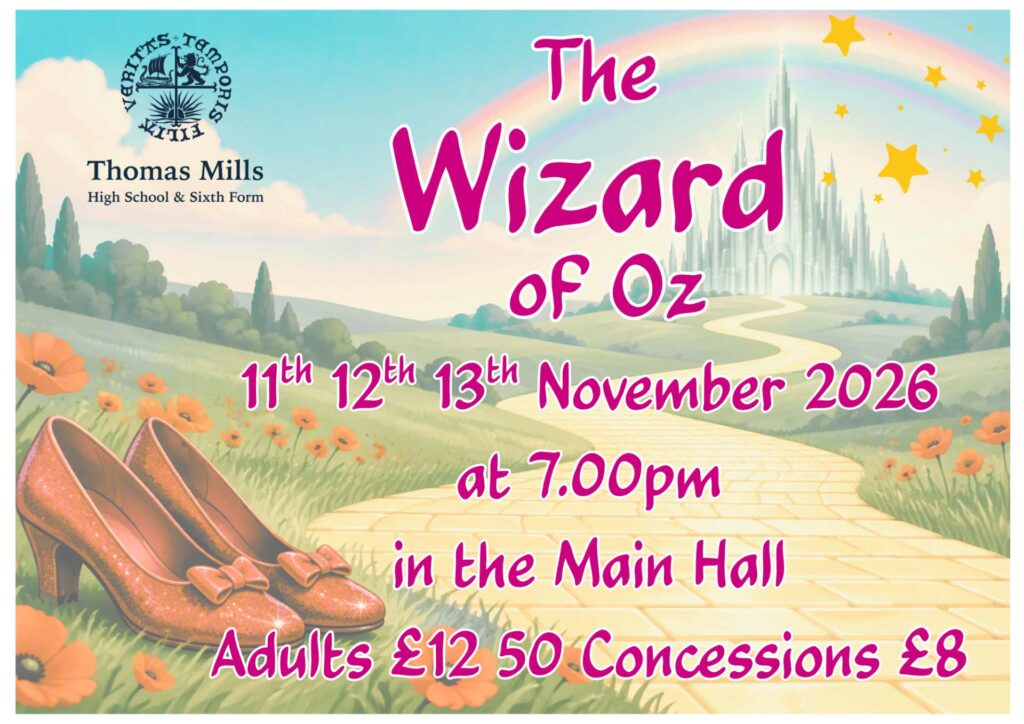
The Wizard of Oz

Don’t forget to book your tickets for performances on Wednesday 11th and Thursday 12th November. Friday 13th November is now sold out!Â