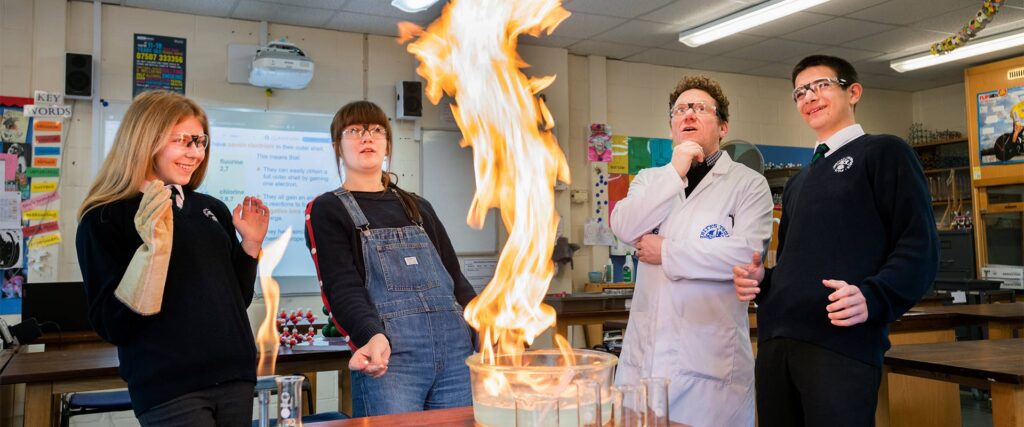
A Level Chemistry is a challenging but rewarding course, looking at the world around us in depth.

A Level Chemistry is a challenging but rewarding course, looking at the world around us in depth.
The first year of OCR A-Level Chemistry A develops students’ understanding of fundamental chemical principles while building the practical, mathematical, and analytical skills required for advanced study. Through the units of study, students establish a secure foundation in both theoretical and experimental chemistry.
The practical endorsement develops continuous practical and investigative skills, enabling students to:
Students study the core foundations of chemistry, applying mathematical models and spatial reasoning to explore atomic structure, the mole concept, acid-base reactions, bonding, and periodicity. In the subsequent topics, the focus shifts to physical and core organic chemistry, introducing students to enthalpy changes, reaction rates, dynamic equilibrium, hydrocarbons, alcohols, organic synthesis, and modern analytical techniques.
Throughout the course, students are encouraged to think critically, solve complex problems, and communicate scientific ideas accurately using appropriate terminology and mathematical techniques. By the end of Year 1, students will have developed a coherent understanding of core chemical concepts and practical skills, providing a strong foundation for the second year of the course and future scientific study.
Knowledge:
Students develop a secure understanding of core chemistry across atoms, reactions, electrons, bonding, and structure. In Atoms and Reactions, this includes atomic structure, isotopes, mass spectrometry, the mole concept, reacting masses, and stoichiometry. Students also study acid-base reactions, titration calculations, oxidation numbers, and redox principles.
In Electrons, Bonding and Structure, learners explore electron configuration, orbitals, and the nature of ionic, covalent, and metallic bonding. They link microscopic structure and intermolecular forces to macroscopic behaviour, explaining properties such as melting points, boiling points, and electrical conductivity across different lattice structures (giant and simple).
Across these topics, students apply mathematical relationships to calculate chemical quantities, interpret mass spectra, and solve multi-step stoichiometric problems. They develop an understanding of how these principles explain real-world systems, such as chemical yields, the physical properties of materials, and fundamental chemical reactivity.
This knowledge base provides the essential foundation for further study in fields such as physical chemistry (kinetics and thermodynamics), organic synthesis, and transition metal chemistry in later modules.
Skills:
Students develop core practical and investigative skills, including planning and refining experiments, selecting appropriate apparatus (such as burettes, pipettes, and volumetric flasks), and working safely and accurately with hazardous substances. They learn to collect reliable data, identify percentage uncertainties, and apply quantitative methods to improve validity.
Students also build competence in data analysis, including evaluating titration results, determining empirical formulae, and using mathematical relationships to quantify chemical systems. Communication skills are developed through the clear presentation of results, the formulation of balanced equations, and scientific reasoning, alongside the ability to critically evaluate experimental methods, percentage yields, and outcomes.
Useful Links
OCR (A) A-level Chemistry Revision – PMT
chemguide: helping you to understand Chemistry – Main Menu
Assessments:
End of unit assessments developed using past exam paper questions.
Practical task assessments
Knowledge:
Students develop a secure understanding of core chemistry across periodicity, group trends, and foundational organic chemistry. In The Periodic Table, this includes the structure of the periodic table, periodicity in physical properties (such as melting points and ionisation energies), and the characteristic chemical behaviours of Group 2 (alkaline earth metals) and Group 7 (the halogens). Students also study qualitative analysis, mastering the systematic tests to identify unknown inorganic anions and cations.
In Basic concepts and Hydrocarbons, learners explore the language of organic chemistry, including nomenclature, empirical and molecular formulae, and various forms of isomerism (both structural and stereoisomerism, including E/Z isomerism). They study the structure, physical properties, and reactivity of alkanes and alkenes, exploring reaction mechanisms such as radical substitution and electrophilic addition, alongside the industrial and environmental importance of polymers.
Skills:
Students develop core practical and investigative skills, including planning and refining experiments, selecting appropriate apparatus (such as Quickfit glassware for heating under reflux and distillation), and working safely with flammable or volatile organic liquids. They learn to collect reliable observational data, carry out systematic test-tube reactions for ion identification, and apply deductive reasoning to identify unknown substances.
Students also build competence in data analysis, including interpreting reaction conditions, drawing accurate 3D representations of organic molecules, and determining limiting reagents. Communication skills are developed through the clear presentation of mechanistic pathways, balanced full and ionic equations, and scientific reasoning, alongside the ability to critically evaluate experimental methodologies, safety protocols, and the sustainability of chemical processes.
Assessments:
End of unit assessments developed using past exam paper questions.
Practical task assessments
Knowledge:
Develop a secure understanding of core chemistry across thermodynamics, kinetics, further organic chemistry, and instrumental analysis. In Physical Chemistry, this includes enthalpy changes, calorimetry, Hess’s Law, and average bond enthalpies. Students also study chemical kinetics, exploring collision theory, the Boltzmann distribution, and the role of catalysts in increasing reaction rates. Furthermore, they explore dynamic equilibrium, applying Le Chatelier’s principle and calculating the equilibrium constant, Kc In Alcohols, Haloalkanes and Analysis, learners explore the physical properties and characteristic reactions of alcohols, including oxidation, dehydration, and substitution. They study the mechanism of nucleophilic substitution in haloalkanes, linking this to the hydrolysis rates of different carbon-halogen bonds and the environmental impact of organohalogens on the ozone layer. They also integrate this knowledge to design multi-step organic synthetic routes. Across these topics, students apply modern analytical techniques, interpreting mass spectra and infrared (IR) spectroscopy graphs to identify functional groups and definitively determine molecular structures. They develop an understanding of how these principles explain real-world systems, such as industrial compromise conditions (e.g., temperature and pressure in the Haber process), the development of sustainable chemical processes, and the forensic analysis of unknown compounds. This knowledge base provides the essential foundation for further study in advanced thermodynamics (entropy and free energy), quantitative rate equations, and advanced structural analysis (such as IR spectroscopy) in later modules.
Skills:
Students develop core practical and investigative skills, including planning and refining experiments, selecting appropriate apparatus (such as spirit burners and polystyrene cups for calorimetry), and working safely with toxic or corrosive organic reagents. They learn to collect reliable temperature and rate data, identify heat losses or measurement uncertainties, and apply graphical methods—such as drawing tangents to concentration-time graphs—to determine rates of reaction.
Students also build competence in practical organic synthesis and purification, mastering techniques such as heating under reflux, distillation, using a separating funnel, and drying organic liquids with anhydrous salts. Communication skills are developed through the clear presentation of Hess’s Law cycles, nucleophilic substitution mechanisms, and spectral analysis reasoning, alongside the ability to critically evaluate experimental yields, product purity, and analytical data validity.
Assessments:
End of unit assessments developed using past exam paper questions.
Practical task assessments
The second year of OCR A-Level Chemistry A builds upon the foundational concepts established in Year 1, deepening students’ understanding of complex chemical principles and refining their advanced practical, mathematical, and analytical skills. Through these demanding units of study, students develop a highly sophisticated, synoptic grasp of both theoretical and experimental chemistry.
The practical endorsement continues to develop high-level investigative skills, enabling students to:
Students study advanced physical chemistry, applying complex mathematical models and quantitative reasoning to explore rate equations, thermodynamics (entropy and free energy), electrode potentials, and acid-base equilibria including buffer solutions. In the inorganic and organic modules, the focus shifts to the intricate chemistry of transition elements, aromatic compounds, carbonyls, and nitrogen-containing organic species. Students integrate this knowledge to design multi-step organic syntheses and master advanced analytical techniques, notably nuclear magnetic resonance (NMR) spectroscopy and chromatography.
Throughout the final year, students are required to synthesise knowledge across different modules, think critically, and solve unstructured, multi-step problems. They are challenged to communicate complex scientific ideas accurately, applying sophisticated terminology and advanced mathematical techniques. By the end of Year 2, students will have developed a comprehensive, synoptic understanding of chemistry, leaving them exceptionally well-prepared for university-level study in the chemical sciences, medicine, engineering, and related STEM fields.
Knowledge:
Students develop a secure understanding of advanced physical and organic chemistry across reaction kinetics, quantitative equilibria, acid-base systems, and aromaticity. In Rates, equilibrium and pH, this includes determining orders of reaction, deriving rate equations, and calculating the rate constant. Students explore the Arrhenius equation and rate-determining steps. They also study quantitative equilibrium, calculating equilibrium constants using partial pressures, and dive deeply into acid-base equilibria. This covers Brønsted-Lowry principles, pH calculations for strong and weak acids, the acid dissociation constant, the ionic product of water, and the action and design of buffer solutions.
In Aromatic compounds, learners explore the structure and bonding of benzene, comparing the historical Kekulé model with the modern delocalised electron model using empirical evidence. They study the characteristic electrophilic substitution reactions of arenes, including nitration, halogenation, and Friedel-Crafts alkylation and acylation. The chemistry of phenol is also examined, alongside the effect of electron-donating and electron-withdrawing directing groups on the substitution of aromatic rings.
Across these topics, students apply complex mathematical relationships to calculate half-lives, equilibrium constants, and buffer pH values. They develop an understanding of how these principles explain real-world systems, such as the formulation of pharmaceuticals, the control of industrial reaction conditions, and the vital biological importance of buffering systems in blood.
This knowledge base provides the essential foundation for further study in fields such as advanced organic synthesis (including nitrogen compounds and polymers), complex transition metal chemistry, and synoptic analytical techniques in the final modules of the course.
Skills:
Students develop advanced practical and investigative skills, including planning and refining experiments, selecting appropriate apparatus (such as continuous monitoring equipment for rates and pH meters for titrations), and working safely and accurately with hazardous aromatic reagents. They learn to collect reliable rate and pH data, identify sources of measurement uncertainty, and apply quantitative methods to improve precision.
Students also build competence in data analysis, including evaluating pH titration curves, determining reaction orders from concentration-time and rate-concentration graphs, and using mathematical relationships—such as the Arrhenius equation—to determine activation energy. Communication skills are developed through the clear presentation of complex electrophilic substitution mechanisms, the formulation of rate and equilibrium expressions, and scientific reasoning, alongside the ability to critically evaluate experimental methods and the validity of theoretical models (such as the structure of benzene).
Useful Links
OCR (A) A-level Chemistry Revision – PMT
chemguide: helping you to understand Chemistry – Main Menu
Assessments:
End of unit assessments developed using past exam paper questions.
Practical task assessments
Prep examinations using past paper questions for units covered.
Knowledge:
Students develop a secure understanding of advanced physical and organic chemistry across thermodynamics, nitrogen-containing compounds, and complex organic synthesis. In Energy, this includes exploring lattice enthalpy and its dependence on ionic size and charge. Students construct and interpret Born-Haber cycles and relate these to enthalpies of solution and hydration. They also study entropy and Gibbs free energy, applying quantitative thermodynamic principles to predict the feasibility of chemical reactions at different temperatures.
In Nitrogen compounds, polymers and synthesis, learners explore the basicity and preparation of aliphatic and aromatic amines, the reactions of amino acids (including zwitterion formation), and the chemistry of amides. They study optical isomerism and chirality, linking this to the synthesis of pharmaceutical drugs. Furthermore, students explore condensation polymerisation (forming polyesters and polyamides) and learn to extend carbon chains using nitriles, combining these skills to design complex, multi-step organic synthetic routes.
Across these topics, students apply mathematical relationships to calculate free energy changes, determine entropy values, and calculate theoretical yields. They develop an understanding of how these principles explain real-world applications, such as the design of biodegradable polymers, the specific stereochemistry required for active pharmaceuticals, and the thermodynamic driving forces behind spontaneous chemical processes.
This knowledge base provides the essential foundation for further study in advanced analytical techniques, transition metal chemistry, and university-level biochemistry or physical chemistry.
Skills:
Students develop advanced practical and investigative skills, including planning and refining multi-step syntheses, selecting appropriate apparatus (such as melting point apparatus and reduced-pressure filtration), and working safely and accurately with hazardous organic reagents. They learn to collect reliable thermodynamic data, measure accurate melting points to determine the purity of synthesised solids, and apply quantitative methods to improve the validity of their experimental yields.
Students also build competence in data analysis, including evaluating entropy changes, predicting reaction feasibility, and calculating reaction quantities. Communication skills are developed through the clear presentation of Born-Haber cycles, comprehensive synthetic pathways, and scientific reasoning, alongside the ability to critically evaluate experimental purity, percentage yields, and the environmental impact of polymer disposal methods.
Assessments:
End of unit assessments developed using past exam paper questions.
Practical task assessments
Prep exam using full exam papers
Knowledge:
Students develop a secure understanding of advanced inorganic and analytical chemistry across complex ions, d-block elements, and structural determination techniques. In Transition metals, this includes the electron configuration of d-block atoms and ions, and the characteristic properties of transition elements, such as variable oxidation states, catalytic behaviour, and the formation of coloured compounds. Students study complex ions, exploring coordination numbers, ligand substitution reactions, precipitation, and stereoisomerism (including cis-trans and optical isomerism in complexes). They also master complex redox titrations, particularly those involving manganate(VII) and iodine/thiosulfate systems.
In Analysis, learners explore advanced instrumental techniques used to determine exact molecular structures. They study chromatography, including thin-layer chromatography (TLC) and gas chromatography (GC), applying Rf values and retention times to separate and identify compounds. Furthermore, students delve deeply into nuclear magnetic resonance (NMR) spectroscopy, interpreting both carbon-13 and high-resolution proton NMR spectra. They analyse chemical shifts, integration traces, and spin-spin splitting patterns to deduce exact structural arrangements of organic molecules.
Across these topics, students apply logical deduction and mathematical relationships to calculate redox titration results, interpret complex combined spectra (bringing together mass spectrometry, infrared, and NMR data), and definitively deduce molecular structures. They develop an understanding of how these principles explain real-world systems, such as the use of transition metals as industrial catalysts, the biochemical action of cis-platin as an anti-cancer drug, and the pharmaceutical application of combined analytical techniques.
This knowledge base represents the culmination of the A-Level course, synthesising understanding from all previous modules and providing an essential foundation for undergraduate study in chemistry, medicine, pharmacology, and materials science. the essential foundation for further study in advanced thermodynamics (entropy and free energy), quantitative rate equations, and advanced structural analysis (such as NMR spectroscopy) in later modules.
Skills:
Students develop advanced practical and investigative skills, including planning and refining experiments, selecting appropriate apparatus (such as TLC plates, chromatography equipment, and precise volumetric glassware), and working safely with hazardous transition metal compounds and volatile organic solvents. They learn to collect reliable data, perform quantitative redox titrations to a high degree of accuracy, and carry out systematic qualitative test-tube reactions to identify unknown transition metal ions and their complex states.
Students also build competence in data analysis, including calculating exact concentrations and percentage purities from redox titrations, and determining unknown structures by synthesising multiple streams of analytical data. Communication skills are developed through the clear presentation of complex ion 3D geometries, complex full and ionic redox equations, and step-by-step structural deduction reasoning, alongside the ability to critically evaluate experimental precision, chromatographic separations, and the validity of analytical conclusions. heating under reflux, distillation, using a separating funnel, and drying organic liquids with anhydrous salts. Communication skills are developed through the clear presentation of Hess’s Law cycles, nucleophilic substitution mechanisms, and spectral analysis reasoning, alongside the ability to critically evaluate experimental yields, product purity, and analytical data validity.
Assessments:
End of unit assessments developed using past exam paper questions.
Practical task assessments
Prep exams using full papers
Exam Board:
OCR
Course Code:
Chemistry A H432


Don’t forget to book your tickets for performances on Wednesday 11th and Thursday 12th November. Friday 13th November is now sold out!