Term 1
Courtney Pine
Danny Elfmann
Beatles
Bernard Hermann
Knowledge:
These works are selected at the beginning of the course for their relative accessibility and clear musical structures, enabling pupils to develop secure understanding of core musical elements including functional harmony, melodic riff-based writing, strong pulse, and clearly defined structures.
Through these works, pupils develop knowledge of:
- Harmony: triadic and extended chords, tonal centres, basic harmonic progressions
- Rhythm: simple and swung rhythmic patterns, groove and pulse
- Structure: song form, riff development, and motivic repetition
- Timbre and texture: studio production techniques and orchestration
- Style and context: popular music, jazz fusion, and film music conventions
Skills:
Knowledge of the set works is developed through analysis of other wider listening pieces, requiring pupils to apply their knowledge to similar pieces using their analytical skills. Students are also taught essay writing skills to enable them to construct a controlled argument when explaining the effect of a composer’s techniques.
Knowledge from the set works is applied through composition tasks designed to develop stylistic fluency and creative control. Pupils learn to:
- construct and develop riffs and melodic ideas
- apply extended harmonic language in popular song contexts
- compose effectively for mood using timbre, harmony and texture
- develop awareness of film music techniques such as motif and suspense writing
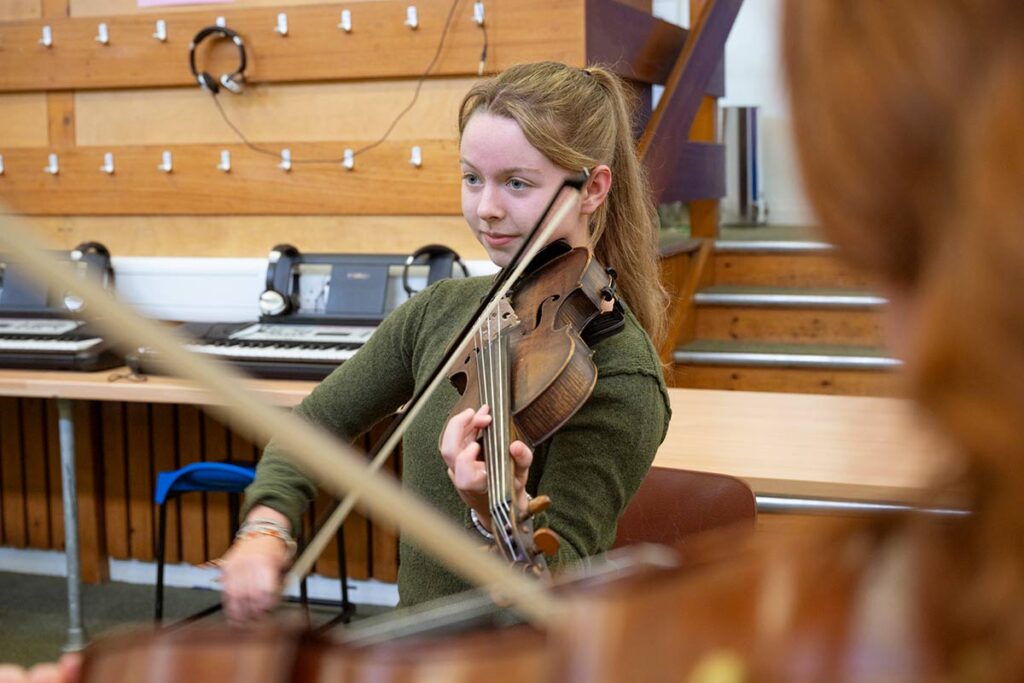
Performance skills are developed through peripatetic tuition, ensemble participation, and structured in-class performance opportunities, supporting technical accuracy, stylistic awareness and ensemble confidence.
Useful Links
AS-Courtney-Pine-set-work-support-guide.pdf
AS-Elfman-Batman-set-work-support-guide.pdf
A-level-Beatles-set-work-support-guide.pdf
A_level_Herrmann_Psycho_set_work_support_guide.pdf
Assessments:
- Students will complete a listening question and a 20 mark or 30 mark essay for each set work studied to include a total of at least 4 in the first term. Feedback with clear suggestions for improvement given.
- Composition skills assessed through the submission of a first composition idea.
- Solo performance assessment undertaken.
Term 2
J.S. Bach
Clara Schumann
Kate Bush
Knowledge:
During this term, pupils develop and expand their knowledge of how Western Art Music evolves from functional tonal organisation and simple structures to contrapuntal writing and expanded. Through the set works, pupils develop knowledge of:
- Tonality and harmony: Functional tonality and modulation (Bach, Schumann), cadential progressions and Romantic chromaticism, and extended harmonic language in contemporary popular music (Kate Bush).
- Texture: Polyphonic counterpoint and imitation (Bach), contrasts between homophonic and contrapuntal writing (Schumann), and layered studio production techniques (Kate Bush).
- Structure: Binary, ternary, and ritornello principles (Bach), sonata form and thematic development (Schumann), and concept albums (Kate Bush).
- Melody and thematic development: Chorale and imitation (Bach), lyrical Romantic melody (Schumann), and hook development with studio manipulation (Kate Bush).
- Timbre and stylistic awareness: Baroque articulation and continuo textures, Romantic chamber ensemble balance, and studio production as a compositional device.
Skills:
Students refine analytical skills by identifying stylistic features across Baroque, Romantic, and contemporary popular music, and are taught to construct well-structured, evidence-based written responses using accurate musical vocabulary and controlled argumentation.
Knowledge from the set works is applied through composition tasks designed to develop stylistic fluency, harmonic control, and increasingly sophisticated musical decision-making.
Performance skills are developed through peripatetic tuition, ensemble participation, and structured performance opportunities, with a focus on stylistically informed interpretation, technical refinement, ensemble awareness, and expressive control.
Useful Links
Eine Feste Burg
A_level_Schumann_Piano_Trio_set_work_support_guide.pdf
A_level_Kate_Bush_Hounds_set_work_support_guide.pdf
Assessments:
- Students will complete a listening question and a 20 mark or 30 mark essay for each set work studied to include a total of at least 4 in the second term. Feedback with clear suggestions for improvement given.
- Composition skills assessed through the submission of a composition idea.
- Solo performance assessment undertaken.
Term 3
Vaughan Williams
Debussy
Knowledge:
During this term, pupils develop and expand their knowledge of how Western Art Music moves beyond functional tonality into modality, impressionism, and timbre-led composition. Through the set works, pupils develop knowledge of:
- Tonality and harmony: Modal and non-functional harmony (Vaughan Williams, Debussy), including parallel harmony, harmonic ambiguity, and colour-based harmonic movement.
- Texture: Word painting and orchestral contrast (Vaughan Williams), and transparent, layered impressionist textures (Debussy).
- Structure: Through-composed and text-driven forms (Vaughan Williams), and flexible, impressionist structures (Debussy).
- Melody and thematic development: Text-driven melodic contour and pastoral lyricism (Vaughan Williams), and motif shaped by colour and contour rather than function (Debussy).
- Timbre and stylistic awareness: Orchestration as expressive device, tone colour, pedalling, and impressionist sound world.
Skills:
Students refine analytical skills by identifying stylistic features across impressionist and pastoral repertoire, and constructing well-structured, evidence-based responses using accurate musical vocabulary and controlled argumentation.
Knowledge from the set works is applied through composition tasks designed to develop control of timbre, texture, and non-functional harmony. Pupils might choose to explore the following in their free composition:
- compose using modal and impressionist harmonic language
- apply parallel harmony and non-functional harmonic movement
- develop texture-led and atmospheric composition techniques
- use word painting and text-sensitive melodic writing
Performance skills are developed through peripatetic tuition and ensemble participation, with a focus on stylistically informed interpretation, tone colour, expressive control, and refined ensemble awareness.
Useful Links
A-level-Vaughan-Williams-set-work-support-guide.pdf
AS-Debussy-set-work-support-guide.pdf
Assessments:
- Students will complete a listening question and a 20 mark or 30 mark essay for each set work studied to include a total of at least 4 in the third term. Feedback with clear suggestions for improvement given.
- Composition skills assessed through the submission of a free composition.
- Solo performance assessment undertaken.