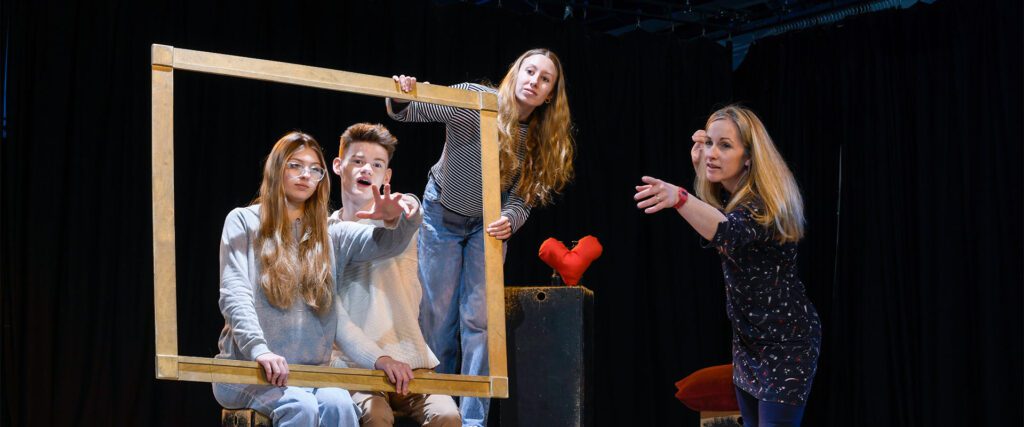
This course is suited to individuals who are keen to explore and develop their understanding of theatre. As part of this course students will take on the role of director, actor, researcher and scriptwriter in their exploration of bringing texts to life or creating their own devised work.
The Drama and Theatre curriculum at Thomas Mills High School and Sixth Form enables students to become confident, creative and reflective theatre-makers. Through performance, devising, design and the study of dramatic texts, students develop a deeper understanding of how theatre communicates ideas, emotions and social issues to an audience.
Substantive Knowledge: Students explore influential theatre practitioners, theatrical styles, performance texts and live theatre, developing an understanding of how creative choices shape meaning and audience response.
Ways of Knowing: Students learn how theatre is created through practical exploration, rehearsal and collaboration. They develop skills in creating, performing, analysing and evaluating drama, while learning to justify artistic decisions using appropriate theatrical language.
Personal Knowledge: Through engaging with a range of characters, themes and perspectives, students develop empathy, confidence and self-awareness. They are encouraged to express their own ideas creatively while reflecting on the experiences and viewpoints of others.
Practical exploration remains at the heart of learning, supported by discussion, written analysis and evaluation. This combination of creative and academic study develops independent thinking, communication skills and a lasting appreciation of theatre and performance.
Term 1
Development of theatre practitioners
Knowledge:
Students are introduced to A Level Drama and Theatre through the study of influential practitioners including Stanislavski, Brecht and Frantic Assembly. They explore how different theatre styles, genres and performance techniques communicate meaning to an audience. Through the study of Love and Information, students begin the devising process, considering how themes, structure, context and theatrical conventions can inspire original performance work.
Practitioner research presentations (Stanislavski, Brecht, Frantic Assembly)
Rehearsal process evaluations
Devising workshop explorations
Research tasks on devising text Love and Information.
Term 2
Development of the Devising Unit.
Live Theatre
Introduction to Colder Than Here
Knowledge:
Students develop and refine an original devised performance inspired by practitioner influences and stimulus material. Alongside the practical work for component one, students are introduced to Colder Than Here, exploring character, themes, dramatic structure and performance potential. Students also begin analysing live theatre productions and considering the role of actors, directors and designers in creating meaning for an audience.
Skills:
Creating and developing devised performances
Reflecting on and evaluating creative processes
Writing about live theatre and performance
Analysing dramatic texts from different perspectives
Developing rehearsal and performance skills
Building independent research and communication skills
Devised performance work in progress- peer feedback
Portfolio evidence and reflective writing for Component 1 (NEA)
Live theatre review or evaluation
Set text acting questions – Colder Than Here
Set text design questions – Colder Than Here
Examination-style written responses- Live Theatre and set text questions
Performance of Component 01NEA
Term 3
Introduction to set text ‘Woyzeck’
Introduction / Monologue-Duologue Introduction.
Knowledge:
Students are introduced to Woyzeck as a set text for the Edexcel A Level course, exploring its themes, context and potential interpretations in performance. They investigate how directors, actors and designers may bring the text to life for contemporary audiences. Through monologue and duologue work, students further develop their understanding of characterisation and theatrical interpretation in preparation for Component 02.
Skills:
Interpreting and performing scripted texts
Exploring character and relationships in performance
Developing vocal, physical and communication skills
Creating and presenting design concepts
Analysing texts from actor, director and designer viewpoints
The Drama and Theatre curriculum at Thomas Mills High School and Sixth Form enables students to become confident, creative and reflective theatre-makers. Through performance, devising, design and the study of dramatic texts, students develop a deeper understanding of how theatre communicates ideas, emotions and social issues to an audience.
Substantive Knowledge: Students build upon their knowledge of influential theatre practitioners, theatrical styles, performance texts and live theatre developed in Year 12. They deepen their understanding of how creative, directorial and design choices shape meaning and audience response through the study of set texts, live theatre evaluation and the interpretation of performance texts for Component 2 and Component 3 of the Edexcel A Level Drama and Theatre course.
Ways of Knowing: Students learn how theatre is created through practical exploration, rehearsal and collaboration. They continue to develop skills in creating, performing, analysing and evaluating drama, while becoming increasingly independent in their ability to justify artistic decisions using specialist theatrical vocabulary, contextual understanding and evidence from both text and performance. Students refine their ability to interpret, question and critique theatrical choices from the perspectives of performer, director and designer.
Personal Knowledge: Through engaging with a range of characters, themes and perspectives, students develop empathy, confidence and self-awareness. They are encouraged to express their own ideas creatively while reflecting on the experiences and viewpoints of others. As they progress through Year 13, students become increasingly reflective practitioners who can evaluate their own work, respond to feedback and make informed artistic decisions.
Practical exploration remains at the heart of learning, supported by discussion, written analysis and evaluation. This combination of creative and academic study develops independent thinking, communication skills and a lasting appreciation of theatre and performance. In Year 13, students consolidate and apply the knowledge, skills and understanding developed in Year 12 through the study of live theatre, Colder Than Here and Woyzeck, alongside the completion of their Component 2 performance.
Term 1
Component 2: Texts in Practice
Component 3: Theatre Makers in Practice
Knowledge:
Students build upon their understanding of theatrical style, practitioner influence and text interpretation developed in Year 12 through the study of their chosen monologue or duologue performance text. They deepen their knowledge of how performers, directors and designers communicate meaning to an audience whilst developing their understanding of Colder Than Here by Laura Wade and Woyzeck by Georg Büchner. Students explore how context, character, structure and theatrical intention shape both performance and audience response.
Skills:
Interpret and realise character through performance.
Apply rehearsal techniques to refine performance work.
Conduct independent contextual and textual research.
Students consolidate and apply their understanding of performance, interpretation and audience engagement through the completion of Component 2, including the performance of a monologue or duologue and participation in a group performance. Alongside their practical work, students continue their study of Section A (Live Theatre Evaluation), Section B (Colder Than Here) and Section C (Woyzeck), developing a deeper understanding of how performers, directors and designers communicate meaning. This ongoing preparation supports the transition from practical assessment to the final written examination.
Skills:
Demonstrate confident vocal, physical and interpretative performance skills.
Sustain character and dramatic intention throughout performance.
Analyse and evaluate performance, design and directorial choices.
Apply contextual understanding to live theatre and set texts.
Construct analytical and evaluative written responses.
Apply knowledge and understanding when analysing, evaluating and creating theatre.
Reflect critically on rehearsal and performance processes.
Assessed Component 2 monologue or duologue performance.
Statement of Intent submission.
Full mock written examination.
Term 3
Component 3 Final Examination Preparation and External Examinations
Knowledge:
Students consolidate and connect knowledge from across the A Level course, revisiting key themes, contexts, practitioners and theatrical concepts. Through continued study of live theatre, Colder Than Here and Woyzeck, students develop a secure understanding of how meaning is constructed and interpreted in theatrical performance. They refine their understanding of assessment objectives and examination expectations in preparation for the final written examination.
Skills:
Analyse and evaluate theatre with confidence and precision.
Construct well-developed written arguments.
Select and apply appropriate textual and performance evidence.
Write effectively under timed conditions.
Revise independently and strategically.
Synthesize knowledge from across the course.
Demonstrate critical thinking and evaluative judgement.
Edexcel A Level Drama and Theatre written examination.
Type of Qualification:
A Level
Course entry requirements:
Drama GCSE preferable
Are you interested in:
Learning about different approaches to theatre, extending your knowledge of theatre practitioners, exploring a variety of play texts, working creatively in a team, performing to an audience or taking a practical subject to complement your curriculum choices?
Leading to a career in:
Hospitality, retail sales and customer services, broadcast media and the performing arts. Such as: theatrical producer, primary/secondary teacher, arts administrator, wedding planner
The subject goes well with:
• English Language
• English Literature
• Classics