The Thomas Mills High School & Sixth Form Music curriculum aims to provide pupils with musical experiences that help them develop technical and expressive skills alongside musical knowledge. The course is designed to cover singing, the playing of various instruments, composing, improvising and critical appraisal of music. Assessment will focus on the following areas:
The focus within KS3 music is firmly on practical music-making with plenty of opportunities to compose, perform, sing and listen to music. Pupils will learn ‘in’ music and not just about music.
For further details about Music at Key Stage 3 or 4, or to discuss your child’s progress, please contact the school office.
Students will learn about basic musical notation, including note values and time signatures. They will practise clapping the pulse in music and perform simple rhythms from notation using body percussion, such as clapping and stomping.
They will also be introduced to a rhythm performance piece and perform this as a class and in groups.
In groups, students will compose their own rhythmic piece through improvisation and begin to notate their rhythms. These layered rhythms will create more complex polyrhythms.
Useful Links
Rhythm – Music literacy – National 5 Music Revision – BBC Bitesize
Pitch – Music literacy – National 5 Music Revision – BBC Bitesize
Students will then be introduced to pitch by learning the notes of the treble and bass clefs. They will identify these notes on the keyboard and develop basic keyboard skills. Using words (e.g., “dead cabbage”), they will create a composition that combines their understanding of rhythm and pitch. They will notate their word composition to embed the connection between written notation and sound.
Finally, students will end the term by learning and performing a piece as a class. The different parts will increase in difficulty, and students who play an instrument will have the opportunity to perform on their own instrument alongside the keyboards.
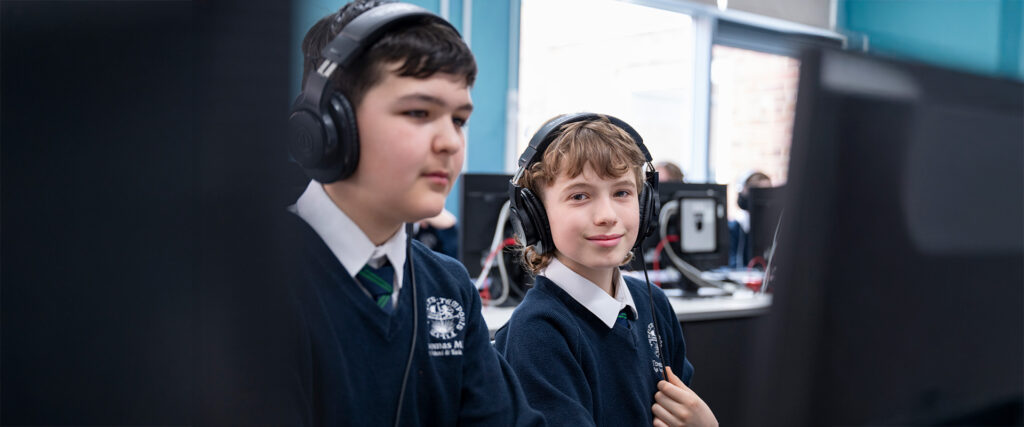
In Term 1 of Music Technology, pupils will explore music technology through composing a short song using GarageBand. They’ll learn how to use basic features such as saving, adding loops, recording, and layering tracks. Over the term, they will create compositions that include drum, bass, and melody lines, and build their understanding of musical structure using an ABA (ternary) format. Students will also learn to construct chord sequences in C major, record melodies with shape and repetition, and use arpeggiators for bass lines. Lessons gradually develop skills, beginning with selecting loops and adding drummer tracks, then progressing to original compositions with contrasting sections.
In the second half of Term 1, pupils will explore how music enhances film through a technique called ‘mickey mousing’, where music closely matches on-screen action. Using GarageBand, they’ll compose original music for a short film clip, developing skills in sound selection, timing and mood. Pupils will study professional examples, experiment with loops, and learn to use drones and transitions effectively. They’ll refine their work over several lessons with ongoing feedback, culminating in a final composition. The unit supports creativity, critical listening, and technical development.
Assessments:
There are three assessments this term.
The first assessment is of the group percussion compositions and will evaluate pupils’ ability to both perform and notate interesting rhythms, demonstrating both technical and expressive skills.
The second assessment will focus on their word composition and will assess their ability to compose imaginative ideas and notate simple melodies.
The third assessment will evaluate their keyboard skills, specifically their ability to play with accuracy and fluency.
Pupils will be supported in these assessments by teacher and pupil modelling, whole class feedback and verbal feedback throughout the lessons.
During the first half term, pupils will prepare for a Year 7 Class Singing Competition. This takes place in the week before half term, where each class performs a song using harmonies and different parts for the rest of the year group. This activity develops their technical knowledge of how their voices work, particularly breath control, diction and intonation, as well as their expressive and performance skills. They will also learn about performance etiquette, including how to behave in a concert and how to perform professionally on stage.
Alongside preparing a song, pupils will learn about the instruments found in an orchestra: how they sound, the mechanics of the instruments, and to which family of instruments they belong. They will also further their constructive knowledge of musical elements and apply their understanding of musical instruments to a listening assessment based on Holst’s ‘The Planets’.
Useful Links
BBC National Orchestra of Wales – Strings – YouTube
BBC National Orchestra of Wales – Woodwind
BBC National Orchestra of Wales – Percussion
BBC National Orchestra of Wales – Brass
Holst: The Planets, ‘Mars’ – BBC Proms
During the second half term, pupils will explore how music is used in celebration. They will learn about the culture of Brazilian Samba music and key musical features such as call and response, polyrhythm and cyclic patterns. As a class, they will learn to perform Samba Batucada and will be introduced to key instruments including: surdo, caixa, tamborim, agogô, repinique, ganza, and whistle (apito). They will study the structure of Samba: introduction, groove, break, call, response and ending, and will learn to follow the leader using whistle cues.
Finally, pupils will create their own Samba rhythms in groups, incorporating all the key features they have learned.
This term, pupils will create music for a fictional advert, learning how sound shapes mood and message. Using GarageBand, they will write and record a voiceover script, compose music using major and minor chords to reflect changing emotions, and add sound effects using a technique called Foleying. Pupils will also create a short, catchy jingle featuring their product’s name. Throughout the unit, they will explore how rhythm, harmony and instrumentation influence audience response.
Pupils will then explore the genre of minimalism in music. They will learn about its origins and key characteristics, such as repetition, layering of short ostinatos, looping, phase shifting, modulation and note addition/subtraction. Pupils will compose their own minimalist pieces using these techniques and identify them in the works of others. Key resources include pieces by Terry Riley, John Adams and Steve Reich.
Useful Links
Basic Samba Batucada Lesson with Marcus Santos
Assessments:
There are two assessments this term.
The first is a written appraisal task about Holst’s ‘The Planets’ with focus on the musical elements. This assessment includes written feedback from the teacher and an opportunity to develop from that feedback.
Pupils will be supported with this assessment by working through some examples as a class, teacher and pupil modelling, key word banks and sentence starters.
The second assessment will be of the student’s samba performances and their ability to play with fluency, accuracy and with a sense of style. Pupils will be given plenty of verbal feedback as individuals and in groups.
The first half term will focus on programme music, including repertoire such as Mussorgsky’s ‘Pictures at an Exhibition’, Saint-Saëns’ ‘Carnival of the Animals’ and Vivaldi’s ‘Four Seasons’.
Students will create an Enchanted Forest composition on keyboards and their own instruments that includes leitmotifs (musical ideas to represent a character or theme) and begin to think about the structure of this piece. They will build on their understanding of sonority, such as the effect of the sound of different instruments, and aim to incorporate a balance of repetition and contrast in their music.
Useful Links
Modest Mussorgsky: Pictures at an Exhibition (orch. Ravel)
Composing music for film – KS3 Music – BBC Bitesize
Pupils will learn about the key features of British and Irish folk music, particularly the use of different metres (e.g. jigs in 6/8 and reels in 4/4) and different scales (e.g. pentatonic and modal scales).
They will learn a simple piece of folk music in small groups and begin to consider phrasing and structure. Pupils will have the opportunity to experiment with guitar, as well as keyboard and voice. They will also go on to develop their own folk-style melodies, using some of the features they have learned including simple harmonies, call and response melodies and drones.
Useful Links
Musical journeys: Folk music – BBC Bitesize
Pupils will focus on creating a Ground Bass and a Battle scene compositions. They will learn about the features of ground bass, such as repetition and bass parts, and how to compose their own using the pentatonic scale. Pupils will combine all of the techniques they have learnt about melody, harmony and loops to create a composition representing a gang fight between two different gangs.
In the musique concrete and remix unit, pupils will learn about the development of musique concrete and remixing. They will discuss the nature of music, use techniques like splicing and reverse playback, and create compositions using everyday sounds. Pupils will learn how modern-day remix also uses similar processing techniques and learn to transpose and match loops to fit vocal samples for their remixes.
Assessments:
There will be two assessments this term.
The first is an assessment of their group compositions, particularly looking at how successfully their ideas match a theme/character. Teacher and pupil models will be used as well as verbal feedback throughout the composition process.
The second assessment will be of the group folk composition, with particular attention to whether pupils have included the key musical features of the genre. They will be reminded of these key features and there will be frequent use of teacher and pupil models, as well as verbal feedback.
During the first half term, pupils will learn to improvise vocally using scat singing and instrumentally using the Dorian mode, helping them build creativity and confidence in musical expression. As part of their ensemble work, students will perform a blues piece together, developing their keyboard skills and gaining a deeper understanding of the structure and style of the genre. This will enable them to understand how the blues is constructed to aid their compositions next half term.
During the second half term, pupils will be introduced to the rich history of the Blues, gaining insight into its cultural roots and significance. They will continue to use the 12-bar blues chord sequence, which forms the foundation of many classic Blues songs, and begin to create their own bass line, lyrics and vocal melody. Students will also listen to and appraise a variety of Blues pieces, developing their ability to recognise key musical features and express their own opinions about the music they hear.
Useful Links
Blues – Popular music styles – National 5 Music Revision – BBC Bitesize
Unit: Band Musicianship 2: The Blues | KS3 Music | Oak National Academy
Assessments:
There are three assessments this half term.
The first assessment will be of the pupils’ improvisation skills, and they will be supported with teacher and pupil modelling.
The second assessment will be of their group Blues’ songs. Pupils will be given plenty of verbal feedback throughout the composition process, as well as teacher and pupil modelling.
The final assessment will be a listening and appraising assessment, where pupils listen to a Blues song and identify some of the key musical features. They will be supported with key word banks, and they will also have an opportunity to reflect and respond on written feedback from the teacher (DIRT feedback).
Pupils will learn about the key features of reggae music, as well as its cultural significance and how it has been influenced by other genres they have studied, such as blues and popular music. They will explore important musical elements of the genre, including offbeat chords and melodic, syncopated basslines. As a class, pupils will perform a reggae song with differentiated parts on the keyboards.
Useful Links
Reggae – Popular music styles – National 5 Music Revision – BBC Bitesize
During this unit, pupils will learn about popular music styles and how they developed from genres such as the blues. They will learn how to play simple four-chord progressions and perform a simple pop song using keyboards, guitars, voice and other classroom instruments. Pupils will then develop their own four chord progressions and create catchy melodic riffs. They will also learn about the structure of pop songs and use a verse-chorus form.
Useful Links
Unit: Band Musicianship 1: The four-chord trick | KS3 Music | Oak National Academy
Assessments:
Pupils will have two assessments this half term.
The first assessment will be of a reggae music performance. They will be supported by verbal feedback as well as modelling. They will be assessed on their ability to perform with accuracy and fluency as well as with a clear sense of rhythm.
The second will be a performance assessment of a popular song and their ability to perform stylistic conventions of pop music, such as four-chord progressions and verse-chorus structures. They will be supported by verbal feedback and teacher and pupil models.
In this unit, pupils will explore how music is used in video games to create mood and atmosphere. They will listen to and analyse game soundtracks, perform some simple video game music and then compose their own music for gaming scenes using a DAW (Digital Audio Workstation), such as GarageBand. Pupils will learn how to use loops, layers and motifs to enhance gameplay and storytelling and structure music for different gaming environments (e.g. action, suspense, victory).
Useful Links
Composing music for video games – KS3 Music – BBC Bitesize
Pupils will learn about fusion music, the blending of two unique styles, and create their own fusion music using a DAW. They will experiment with creating fusion music by blending rhythms, scales and instrumentation from different genres with electronic western popular music (e.g. Afrobeat, Indian fusion). For an Indian fusion piece, pupils will include elements of tala rhythmic cycles, raga scales and Indian instrumentation with western style chord progressions and basic mixing techniques (volume, panning, EQ). They will also think about how to create a build and drop within their music, elements found in EDM (Electronic Dance Music).
Useful Links
Unit: Fusions | KS3 Music | Oak National Academy
Assessments:
Both assessments will be of pupils’ compositional skills.
The first will be of their ability to create convincing gaming music ideas that fit with a theme. Modelling with GarageBand is used by the teacher in each lesson as well as pupil and teacher verbal feedback.
The second assessment will be of pupils’ fusion composition, particularly whether they have managed to successfully combine two different styles of music.
The Thomas Mills High School & Sixth Form GCSE Music Curriculum is based on the Edexcel course. The Edexcel GCSE Music curriculum aims to develop well-rounded musicianship by integrating technical, constructive and expressive knowledge through performing, composing and appraising.
Together, these areas ensure that students become confident, creative and analytical musicians, capable of engaging critically with a wide range of musical styles. The main assessments this year are centred around the three important elements of the GCSE examination: performing, composing and appraising. The final GCSE exam comprises all the elements with 30% for performing (solo and ensemble), 30% for composing (free composition and brief composition) and 40% for the appraising paper.
In the Autumn term, students focus on solo performance, developing technical and expressive skills to perform fluently and confidently. They are supported with this through regular practice sessions and advice on how to rehearse and improve.
Useful Links
Musical performance – Musical performance – Edexcel – GCSE Music Revision – Edexcel – BBC Bitesize
They explore vocal set works (Killer Queen and Music for a While), enhancing their listening and analytical skills and embedding their knowledge of the key musical elements (harmony, melody, rhythm, etc.).
Useful Links
Killer Queen – Queen: Killer Queen – Edexcel – GCSE Music Revision – Edexcel – BBC Bitesize
The pupils also build on prior composition knowledge through structured exercises, reinforcing musical concepts and encouraging creativity. Students also learn key musical vocabulary and apply it in context through listening tests. This foundation prepares students for GCSE expectations. The curriculum supports cultural development and social interaction through shared music-making.
Assessments:
There are three areas for assessment this term.
The first is a baseline solo assessment to gauge their ability as performers with the GCSE exam criteria.
The second is submission of a series of composition exercises, which they have been supported to develop over the term.
The third assessment are listening tests based on Killer Queen and Music for a While, which are from GCSE exam papers. Pupils will be supported through these by going through the questions in advance as a class.
This term centres on ensemble performance, where students learn to communicate musically as a group. They prepare for a class concert, enhancing cooperation and performance confidence.
Useful Links
Free composition begins, using digital tools such as GarageBand and Logic, to create original music with guidance and individual feedback. Pupils have the opportunity to use the Gingerbread studios for their compositions.
Appraising skills are developed further through analysis of the set works and wider vocal music, with an emphasis on applying musical terminology and comparative listening.
Assessments:
Pupils will be assessed on another solo or ensemble performance in a class concert. They will have access to the exam criteria and be supported in how to approach their practice sessions before the concert.
Pupils will submit a draft of their first free composition and be given specific written and verbal feedback to guide them with this.
Pupils will write a comparative essay on Killer Queen and Music for a While. They will be assisted by a writing frame and clear guidance on what to include in each paragraph.
In the Summer term, students continue refining their performance skills, either solo or in ensembles, guided by instrumental or vocal teachers.
Useful Links
The free composition project is completed, with an accompanying written commentary that reflects on compositional choices.
Useful Links
Star Wars – John Williams: Star Wars – Edexcel – GCSE Music Revision – Edexcel – BBC Bitesize
The focus shifts to stage and screen music, analysing Defying Gravity and Star Wars, and comparing them with wider listening examples. Appraising skills are tested through listening tests and extended writing. Pupils will also be introduced to the ‘unfamiliar’ listening question as well as melodic and rhythmic dictation.
Assessments:
Pupils will be assessed on another solo or ensemble performance in a class concert. They will have access to the exam criteria and be supported in how to approach their practice sessions before the concert.
The second assessment will be on the pupils’ ‘unfamiliar’ listening and melodic and rhythmic dictation. Lots of practice examples will be modelled to the class.
The final assessment will be of the written commentary and the pupils are supported with model examples.
Pupils continue to develop their solo performance skills on their chosen instrument or voice, guided by their instrumental or singing teacher. They will focus on accuracy, expression and confidence in preparation for a class concert.
Useful Links
This term introduces pupils to composing music in response to a set brief. They will explore musical ideas and techniques while learning how to shape a short original piece to a brief, e.g. discovery of a new planet.
Pupils study two key instrumental set works: Beethoven’s Pathetique Sonata and Bach’s Brandenburg Concerto. They learn to identify musical elements and understand historical and stylistic context.
Assessments:
Pupils will be assessed through a solo or ensemble performance as part of a class concert at the end of the term. To support this, teachers will provide ongoing verbal and written feedback, helping pupils develop confidence, technique, and musical expression.
For composition, pupils will complete a short piece in response to a set brief. They will receive clear guidance, examples of strong work, and written feedback on their drafts to help them shape and refine their ideas effectively.
In appraising, pupils will sit listening tests on Beethoven’s Pathetique Sonata and Bach’s Brandenburg Concerto. Verbal feedback and class discussion will help pupils understand key features of the set works, supported by teacher modelling of how to approach listening questions and analyse musical elements.
This term focuses on ensemble performance. Pupils develop skills in musical collaboration, timing and communication through rehearsing and performing in small groups or ensembles.
The Spring reintroduces pupils to the free composition component of their GCSE portfolio. Pupils begin planning and creating their own piece with full creative control. They may choose to build on the piece they began in year 9 or start something completely new.
Useful Links
Instrumental Music from 1700 to 1820 – GCSE Music – BBC Bitesize
Set work studies are expanded with additional wider listening. Pupils deepen their analysis of Brandenburg and Pathetique, comparing them to similar styles or contrasting genres through essay writing and discussion.
Assessments:
This term, pupils are assessed on another solo or ensemble performance.
For composition, pupils will submit a free composition draft, accompanied by a written commentary. Teachers will give structured feedback on both the composition and commentary, with examples shared in class to support clarity and creativity in pupils’ work.
Appraising will be assessed through a written comparison essay on Brandenburg Concerto and Pathetique Sonata, with links to wider listening. Pupils will practise this through guided classroom activities, regular feedback and model answers provided by teachers to build confidence in writing and listening analysis.
Pupils refine both solo and ensemble skills, leading to a final class concert performance. They continue to build confidence and musicality through regular practice and peer feedback.
Pupils will continue to work on their free compositions and refine their ideas with regular verbal and written feedback.
Useful Links
Study shifts to Fusion music, with a focus on analysing set works from this genre – Samba Em Preludio by Esperanza Spalding and Release by Afro Celt Sound System. Pupils will further develop their aural skills and essay responses.
Useful Links
Release – Afro Celt Sound System: Release – Edexcel – GCSE Music Revision – Edexcel – BBC Bitesize
Assessments:
There are three assessments this term.
The performance assessment, once again, checks pupils’ progress with this element of the course. Any concerns will be reported to the pupils’ teacher and repertoire choices will be discussed.
Pupils will submit their free composition and commentary. This will be almost finished at this stage and minor suggestions will be made with written and verbal feedback.
Pupils will complete listening tests and essays based on the Fusion set works. Some will now be able to write the essays without a writing frame, but these will be available if necessary. Essays will be discussed and planned as a class before they begin to write them.
Pupils confirm the solo and ensemble pieces they will perform for their GCSE assessments. They continue regular rehearsals and work with instrumental or vocal teachers to refine interpretation and technical accuracy. All necessary documentation is completed, and performance difficulty levels are discussed and agreed upon.
Useful Links
Pupils receive their official composition briefs from the exam board and begin developing ideas for their brief composition. They focus on structure, style and the use of musical elements, supported by teacher examples and modelling.
There is a strong focus on revising the vocal and stage & screen set works. Pupils practise unseen listening questions and longer comparative essays to build confidence and exam technique.
Assessments:
Pupils complete a preparatory performance assessment to monitor progress. They also submit initial ideas for their brief composition. In appraising, there is a formal assessment focused on unseen listening. Throughout the term, pupils receive detailed verbal and written feedback, supported by regular classroom discussion, listening practice, teacher modelling and peer evaluation to build their skills across all areas.
This is the key term for performance assessment. Pupils record both their solo and ensemble pieces for submission. Rehearsals focus on polish and presentation, with attention to accuracy, expression and communication.
Both the free composition and the brief composition are finalised and submitted this term. Pupils refine their work with teacher support, ensuring compositions meet the exam criteria for structure, creativity and use of musical elements.
Useful Links
GCSE Music – Edexcel – BBC Bitesize
Pupils revise the instrumental and fusion set works, develop wider listening knowledge, and practise unseen listening questions. Focus is placed on detailed musical analysis and extended writing.
Assessments:
Pupils are assessed through recordings of both their solo and ensemble performances. They submit their completed free and brief compositions for final assessment. In appraising, pupils sit a preparatory examination to track readiness for the final exam.
Performance assessments have been completed in the Spring Term. This term, the recordings are submitted to the exam board.
All composition work is completed and officially submitted during this term.
Useful Links
Edexcel (Pearson) GCSE Music Past Papers [PDFs]
The focus is now entirely on final revision and preparation for the GCSE listening and appraising exam. Pupils consolidate their understanding of all four areas of study and practise timed questions and exam techniques.
Assessments:
Pupils sit the final listening and appraising examination. Leading up to this, they receive tailored support through mock questions, structured revision sessions and teacher feedback. Pupils are encouraged to refine their essay writing and listening accuracy with the aid of exemplar responses, mark schemes and regular teacher input.
Performing music and creating your own musical ideas or do you enjoy listening to a wide variety of different music?
Performance, composition, teaching, arts administration, recording/music production
Mrs A Ducker