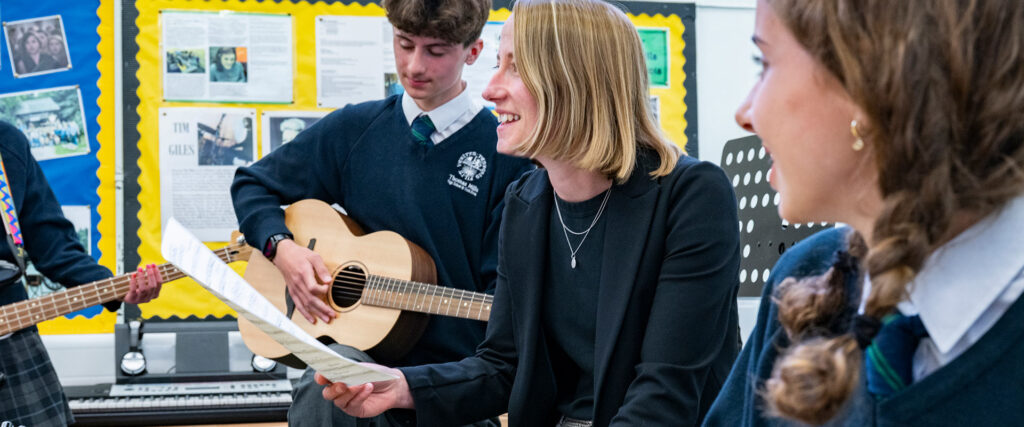
The Drama curriculum at Thomas Mills High School & Sixth Form, delivered across all year groups, reflects the school’s core value of fostering a love of learning for its own sake by developing pupils’ creativity, communication, and confidence. Pupils explore a wide range of dramatic styles and genres through improvisation, rehearsal, and performance, deepening their understanding of language, meaning, and theatrical impact.
Practical exploration and performance are fundamental to the Drama curriculum, with opportunities to reflect both verbally and through written opportunities, thus fostering creativity, collaboration, and confidence.
For further details about Drama at Key Stage 3 or 4, or to discuss your child’s progress, please contact the school office.
Knowledge:
In this topic pupils will be introduced to core drama skills required to develop basic characters and key basic strategies to communicate clearly to an audience.
They will develop basic characterisation skills and developing key actor’s tools. They will be introduced to core drama strategies which will form the basis of devising and how to engage an audience.
Skills:
Pupils will be introduced to core drama strategies as the foundation of learning such as Improvisation, freeze frame, role on the wall, hot seating.
Pupils will explore how to create and communicate a character’s attitude to an audience and develop an ability to place themselves creatively in a situation that may be different to their own life experiences, drawing upon their imagination skills.
Useful Links (1A)
Understanding characterisation guide for KS3 English students – BBC Bitesize
Drama KS3 / KS4: Exploring character types – BBC Teach
Physical habits exercise – Developing characters – GCSE Drama Revision – WJEC – BBC Bitesize
Knowledge:
This scheme of work is designed to support pupils in exploring the complex and sensitive theme of bullying through drama. Pupils will develop an understanding of the emotional, social effects of bullying. They will recognise different forms of bullying, including physical, verbal, social, and cyberbullying, and reflect on the motivations and consequences behind such behaviours through their drama work.
As part of this unit, students will also be introduced to key terms such as bystander and victim and will explore strategies for managing bullying if witnessed. This directly supports the school’s anti-bullying ethos and reinforces the “Speak Up, Speak Out” initiative, encouraging students to take positive action and seek help when needed. The unit is also aligned with the whole-school delivery of Anti-Bullying Week, organised by the Drama Department, promoting empathy, respect, and inclusion through creative expression.
Skills:
Pupils will explore a variety of drama techniques to better understand the issue of bullying and improve their performance skills. They will use improvisation to create scenes based on real-life situations and apply freeze frames to highlight key emotional moments. Through role on the wall and hot seating, they will develop characters and explore different perspectives. The unit includes Theatre in Education (T.I.E) to help pupils use drama to raise awareness, supported by placards to emphasise important messages. Students will also learn how to use body language, facial expressions, movement, and voice to portray characters effectively, while building confidence in performing to an audience and delivering a clear message.
Useful Links (1B)
https://www.bbc.co.uk/bitesize/articles/z7sb6v4
https://www.bbc.co.uk/bitesize/articles/znb9scw
https://www.bbc.co.uk/cbbc/games/the-next-step-take-it-to-the-top-stand-up-to-bullying
Assessments:
1A: Practical performance task demonstrating ability to use key drama skills in presenting a character.
Creation of a Role on the wall for your chosen character
1B: Practical performance assessment of T.I.E
Reflective written account of work explored.
Knowledge:
In this scheme of work pupils will have an introduction to the work of Shakespeare and develop an insight into bringing page to stage. Pupils will explore the basic plot, characterisation and conveying text on stage through the use of physical theatre. Developing a deeper understanding of characters through the use of off text exploration.
Skills:
Pupils will build upon key drama skills from unit 1 and 2. They will interpret sections of the text as both actors and directors, using physical theatre, sound collage, and status exploration. Acting skills—voice, movement, and expression—are further refined alongside speaking, listening, and group collaboration.
Useful Links (2A)
https://www.bbc.co.uk/bitesize/topics/z726yrd/articles/ztx48hv#z2hhsk7
Knowledge:
In this unit, pupils explore the story and characters of Matilda by Roald Dahl, using the film as a stimulus to deepen their understanding of narrative and character development. They examine the concept of escapism, particularly through Matilda’s experiences, and analyse how drama can reflect emotional and social realities.
Skills:
Pupils develop key drama skills including improvisation, freeze frames, hot seating, and role on the wall. They build characterisation by interpreting and conveying emotions, relationships, and motivations. Acting skills such as voice, movement, and expression are refined. Pupils distinguish between naturalistic and non-naturalistic techniques, collaborate effectively, evaluate peer work, and reflect on audience impact, becoming confident, expressive, and thoughtful performers.
Useful Links (2B)
https://www.bbc.co.uk/newsround/36824907
Assessments:
2A: Practical performance task exploring status
Written evaluation of the assessment task.
2B: Practical performance on non-naturalistic techniques
Completion of written end of topic worksheet -an introduction to exam style questions.
Knowledge:
Pupils develop an understanding of Commedia dell ‘Arte, exploring its historical context, stock characters, and traditional performance style. They learn how comedy is created through lazzi (comic routines), cross talk, and audience interaction. Pupils also examine how improvisation and physical exaggeration were central to this theatrical form, gaining insight into how historical performance traditions influence modern comedy.
Skills:
Pupils build upon improvisation and acting skills relevant to this style, focusing on physicality, voice, and comic timing. They practise freeze frames, clocking the audience, and performing lazzi and cross talk. Pupils script short scenes in the Commedia style, collaborate in groups, and evaluate performances. Emphasis is placed on bold characterisation, audience interaction, and meeting creative deadlines, helping pupils become confident, dynamic, and responsive performers.
Useful Links (3A)
Knowledge:
Pupils explore a range of theatrical genres including horror, melodrama, and mystery through mini-script formats. They build on these by creating their own script additions, using them for performance or improvisation. Pupils also learn how genre and structure influence dramatic meaning and how to shape character through both scripted and devised work.
Skills:
Practical work focuses on applying staging techniques such as proxemics, spotlighting, and still image. Pupils also build ensemble and vocal skills through choral speech (canon and unison), mime, and split-stage work, enhancing their ability to collaborate, communicate meaning, and reflect on audience impact.
Useful Links (3B)
https://www.bbc.co.uk/bitesize/articles/zv73vwx#z32b3j6
https://www.bbc.co.uk/bitesize/guides/zjwp2sg/revision/1
Assessments:
3A: Practical performance task demonstrating Commedia style.
End of unit quiz.
3B: Practical performance task of scripted extract.
Knowledge:
In this topic pupils will be introduced to core drama skills required to develop their understanding of tension and atmosphere within drama. They will develop their understanding of storytelling through teacher in role delivery and through developing a character and motive through the plot. They will be introduced to the design elements of sound and lighting and how they can enhance the atmosphere.
Skills:
Pupils will be applying basic core drama strategies to develop their storytelling such as sound corridors, physical theatre and mime.
Pupils will explore a character’s motive and attitude in relation to the plot, placing themselves creatively in a situation that may be different to their own life experiences, drawing upon their imagination skills. Pupils will develop their understanding of how lighting and sound can enhance meaning and atmosphere through symbolism and reflect upon their intended impact on audience.
Useful Links (1A)
https://www.bbc.co.uk/bitesize/guides/z39x34j/revision/3
https://www.bbc.co.uk/teach/class-clips-video/articles/zjt4d6f
GCSE English Literature / Drama: Creating Atmosphere – BBC Teach
Knowledge:
This scheme of work is designed to introduce students to the characteristics and conventions of the British pantomime.
Skills:
Pupils will explore the conventions of pantomime, such as physical comedy, exaggerated acting and stock characters. Pupils will reflect upon design elements associated with pantomime and reflect this in their own performances and evaluative skills.
Useful Links (1A)
https://www.bbc.co.uk/bitesize/articles/zj6gvk7
Assessments:
1A: Practical performance task demonstrating tension.
Written evaluation task.
1B: Practical performance task of a pantomime.
Live theatre evaluation of live or digital recording of a pantomime.
Knowledge:
In this scheme of work pupils will have an introduction to Greek Theatre and a brief overview of placing it within the timeline of theatre development. Pupils will explore the stylised features of Greek theatre.
Skills:
Pupils will gain a brief understanding of the architectural elements of this period, explore performance elements such as Greek chorus, the role of the chorus and performing in this style using movement, speech- canon and unison etc. Emphasis is placed on developing team work to bring the stylistic features of Greek theatre to stage.
Useful Links (2A)
https://www.bbc.co.uk/bitesize/articles/zpdfydm
Knowledge:
This scheme of work focuses on exploring characterisation and staging through selected script extracts. Students will act out key moments to examine character relationships, shifts in status, and emotional development. Emphasis is placed on physicality—such as gesture, movement, and expression—and vocal techniques to portray younger characters.
Skills:
Through practical performance and analysis, learners will develop their understanding of subtext, motivation, and staging elements like proxemics and levels, enhancing both their interpretive and performance skills in drama.
Assessments:
2A: Practical performance task performing a piece of choric ode.
Written assessment task.
2B: Practical performance of a key extract.
Written assessment task.
Knowledge:
Students are introduced to key theatre practitioners—Stanislavski, Brecht, and Frantic Assembly—gaining insight into their core principles and stylistic approaches. They explore Brecht’s use of placards, third-person narration, and episodic structure, alongside Stanislavski’s focus on naturalism, character motivation, and believability.
Skills:
Pupils will gain an understanding of Epic theatre through the application of distancing strategies employed by Brecht such as placards, third person narration, montage, multi-roling etc. Pupils will explore how to develop characters further through the application of motive, objective and subtext. Extension work will explore the work of Frantic Assembly and physical movement and expression.
Useful Links (3A)
https://www.bbc.co.uk/bitesize/guides/zwmvd2p/revision/8
https://www.bbc.co.uk/bitesize/guides/zxn4mp3/revision/1
Knowledge:
This scheme of work focuses on exploring characterisation and staging through selected script extracts. Students will act out key moments to examine the deep and difficult issues that arise in the play.
Skills:
Through practical performance and analysis, learners will develop their understanding of subtext, motivation, and staging elements like proxemics and levels, enhancing both their interpretive and performance skills in drama.
Assessments:
3A: Practical performance influence in the style of Brecht.
End of unit quiz.
3B: Practical performance task of key scene.
Knowledge:
Pupils will build on Key Stage 3 learning by revisiting key practitioners Stanislavski and Brecht through research, practice and homework. They will be introduced to Trestle Theatre masks and explore how to respond creatively to a stimulus, using the poem Matilda and The argument to inspire performance. This course encourages positive group dynamics and deepens understanding of theatrical styles and techniques.
Skills:
Pupils will develop characterisation and performance skills, applying them to create and refine original theatre. They will demonstrate AO1 by generating ideas, AO2 by applying theatrical techniques in live performance, and AO4 by evaluating their own and others’ work.
Useful Links (1A)
https://www.bbc.co.uk/bitesize/guides/z39x34j/revision/3
https://www.bbc.co.uk/teach/class-clips-video/articles/zjt4d6f
Knowledge:
Building on the Year 8 Scheme of Work, pupils will explore the concept of tension in drama, including tension of task, mystery, surprise, and relationships.
Skills:
Pupils will apply acting skills such as physicality, voice, and attitude to convey different types of tension, responding to a stimulus. They will collaborate in groups, developing speaking and listening skills while evaluating each other’s work. Through devising and performing a piece that demonstrates at least two types of tension, Pupils will meet key assessment objectives: AO1 (creating ideas), AO2 (realising performance), and AO4 (evaluating work).
Assessments:
1A: Practical performance task reinforcing understanding
Written lesson evaluation assessment
1B: Practical performance task demonstrating tension through performance and lighting ideas.
Written lesson evaluation.
Knowledge:
In this scheme of work pupils will have an introduction to Greek Theatre and a brief overview of placing it within the timeline of theatre development. Pupils will explore the stylised features of Greek theatre.
Skills:
Pupils will gain a brief understanding of the architectural elements of this period, explore performance elements such as Greek chorus, the role of the chorus and performing in this style using movement, speech-canon and unison etc. Emphasis is placed on developing team work to bring the stylistic features of Greek theatre to stage.
In this unit, pupils will work in small groups to explore and create a piece of theatre using a past exam paper as stimulus. This task is designed to consolidate previous learning and prepare pupils for the expectations of Term 1 in Year 10. Pupils will also complete a mini portfolio documenting the four stages of AO1, reflecting on their creative process.
Knowledge:
Pupils will strengthen their devising and performance skills by generating and developing ideas (AO1), applying theatrical techniques in live performance (AO2), and evaluating their own and others’ work (AO4). Pupils will gain an understanding of how to respond to a stimulus and progress it to a short performance. Research will form part of the initial process.
Skills:
Throughout the unit, students will develop a range of performance and analytical skills. They will create and develop ideas (AO1), apply theatrical techniques in performance (AO2), and demonstrate understanding of how drama is developed and performed (AO3). Pupils will also analyse and evaluate their own work and that of others (AO4), enhancing their speaking, listening, and writing skills. Pupils to develop writing skills in preparation for Year 11.
Useful Links (2B)
https://www.bbc.co.uk/bitesize/guides/zdm3pg8/revision/1
Assessments:
2A: Performance of a key extract from the text.
Written assessment task.
Live theatre practice question.
2B: Student devised performance about 5 minutes in length.
Research and initial ideas page.
Knowledge:
This unit introduces students to the set text for Component 04, focusing on building a foundational understanding of the plot, key characters, and major themes. Pupils will explore how the play spans across time, examining characterisation, setting, and historical context.
Skills:
Throughout this unit, students will develop their ability to interpret and perform scripted material, demonstrating AO3 by showing knowledge of how drama is developed and performed. They will also engage in critical reflection, fulfilling AO4 by analysing and evaluating their own work and that of others. Emphasis will be placed on rehearsal techniques, character development, and understanding staging choices, all of which support both practical performance and written exam preparation.
Useful Links (3A)
https://www.bbc.co.uk/bitesize/guides/z9mgp39/revision/1
https://www.bbc.co.uk/bitesize/guides/zwt4frd/revision/1
https://www.bbc.co.uk/bitesize/topics/z4rvqyc/watch/zgvh9ty
Assessment:
Blood Brothers Homework Question Task x2
Quiz on set text
Knowledge:
In GCSE Drama, students begin by exploring a variety of exciting starting points—these could be themes, stories, images, or real-life events. They’ll research and respond to these stimuli as part of their Component 1 work, learning how to turn ideas into creative performance pieces. All their thoughts, research, and creative decisions are carefully documented in a portfolio, which helps them reflect on their journey and show how their ideas have developed. This process supports their understanding of how theatre communicates meaning and prepares them for more advanced performance works. The work produced is assessed by the teacher and is moderated externally by the exam board. It is worth 30% of the final GCSE Drama grade.
Skills:
Drama at Key Stage 4 is all about building confidence, creativity, and teamwork. Students will learn how to create and shape original ideas (AO1), using drama techniques to bring their stories to life on stage. They’ll also develop performance skills (AO2), such as voice, movement, and characterisation, to express their artistic intentions clearly to an audience. Just as importantly, they’ll learn how to reflect on their own work and give thoughtful feedback to others (AO4), helping them grow as performers and collaborators. These skills are not only essential for drama but are also valuable for life beyond the classroom.
Useful Links
https://www.bbc.co.uk/bitesize/guides/zdm3pg8/revision/1
https://www.bbc.co.uk/bitesize/guides/z7hcy9q/revision/1
https://www.bbc.co.uk/bitesize/guides/zmn9382/revision/1
https://www.bbc.co.uk/bitesize/guides/z6ydrj6/revision/1
Assessments: NEA begins in Term 2
Written: Blood Brothers question Task
Written: Live theatre evaluation – Section B
Performance: NEA Devised work
Written ongoing: NEA Portfolio
Knowledge:
In GCSE Drama, students begin by exploring a variety of exciting starting points—these could be themes, stories, images, or real-life events. They’ll research and respond to these stimuli as part of their Component 1 work, learning how to turn ideas into creative performance pieces. All their thoughts, research, and creative decisions are carefully documented in a portfolio, which helps them reflect on their journey and show how their ideas have developed. This process supports their understanding of how theatre communicates meaning and prepares them for more advanced performance works. The work produced is assessed by the teacher and is moderated externally by the exam board. It is worth 30% of the final GCSE Drama grade.
Skills:
Drama at Key Stage 4 is all about building confidence, creativity, and teamwork. Students will learn how to create and shape original ideas (AO1), using drama techniques to bring their stories to life on stage. They’ll also develop performance skills (AO2), such as voice, movement, and characterisation, to express their artistic intentions clearly to an audience. Just as importantly, they’ll learn how to reflect on their own work and give thoughtful feedback to others (AO4), helping them grow as performers and collaborators. These skills are not only essential for Drama but are also valuable for life beyond the classroom.
Useful Links
https://www.bbc.co.uk/bitesize/guides/zrjsxyc/revision/1
Knowledge:
As part of their GCSE Drama studies, students will explore Blood Brothers by Willy Russell, a powerful and engaging musical that deals with themes such as class, family, fate, and identity. They will study the play’s characters, storyline, and social context. Students will also examine how the play is staged, including set, costume, lighting, and sound design, helping them understand how all elements of theatre work together to tell a story. This knowledge supports their preparation for the written exam and deepens their appreciation of live performance.
Skills:
Through practical workshops and performance tasks, students will bring scenes from Blood Brothers to life. They will develop key performance skills such as voice, movement, characterisation, and stage presence. They’ll also learn how to interpret a script, make directorial choices, and work collaboratively in rehearsals. As part of their assessment, students will analyse and evaluate both their own work and professional productions, building confidence in using Drama vocabulary and reflecting critically.
Useful Links
https://www.bbc.co.uk/bitesize/guides/ztpdbk7/revision/1
https://www.cgpbooks.co.uk/secondary-books/gcse/drama/dmpbb41-gcse-drama-play-guide-blood-brothers
Assessments:
Assessment: NEA Portfolio
Written: Blood Brothers questions
Knowledge:
As part of their GCSE Drama studies, students will work in groups to prepare and perform an extract from a play, which will be assessed by a visiting examiner. To do this successfully, they will study the full play in depth—focusing on its themes, characters, and social and historical context. For example, when exploring Blood Brothers, students will research key issues such as class, family, and fate, and understand how these are presented through the script. They will also sit a full mock exam in January to help them prepare for the written component of the course, developing their ability to analyse and interpret drama in a structured way. The work externally marked by the exam board via a visiting examiner. It is worth 30% of the final GCSE Drama grade.
Skills:
Throughout the course, students will build a wide range of practical and creative skills. They will learn how to develop and shape ideas for performance (AO1), and how to use voice, movement, and stagecraft to bring characters and scenes to life (AO2). They will also gain a strong understanding of how theatre is created and performed (AO3), both through their own work and by studying professional productions. Finally, they will learn to reflect on their performances and give constructive feedback to others (AO4), helping them grow in confidence and creativity—skills that are valuable far beyond the Drama classroom.
Useful Links
https://www.bbc.co.uk/bitesize/guides/zfcmd6f/revision/2
https://www.bbc.co.uk/bitesize/guides/zfcmd6f/revision/1
https://www.bbc.co.uk/bitesize/guides/zjxbnrd/revision/1
https://www.bbc.co.uk/bitesize/guides/zd2vhbk/revision/1
Assessments:
Research of chosen text
Section A assessment week task
Mark a concept example in line with mark scheme
Creation of concept.
Knowledge:
After completing their practical assessments, students will concentrate fully on preparing for Component 04, the written examination. This part of the course focuses on developing a strong understanding of how drama and theatre are created and performed. Students will study a set text in detail, exploring how it could be brought to life on stage through acting, design, and direction. They will also learn how to analyse live theatre performances, considering how different elements—such as lighting, sound, costume, and staging—contribute to the overall impact of a production.
Skills:
In preparation for the written exam, students will build key analytical and evaluative skills. They will learn how to express their ideas clearly in writing, using drama-specific vocabulary to explain how theatrical choices affect an audience. Through regular practice and feedback, they will develop the ability to reflect critically on both their own work and professional performances (AO4), while also demonstrating a solid understanding of how theatre is developed and performed (AO3). These skills not only support exam success but also strengthen communication, critical thinking, and attention to detail.
Assessments:
Assessment: NEA Portfolio
Written: Blood Brothers questions | Past Exam papers
Learning about different approaches to theatre, extending your knowledge of theatre practitioners, exploring a variety of play texts, working creatively in a team, performing to an audience or taking a practical subject to complement your curriculum choices?
Hospitality, retail sales and customer services, broadcast media and the performing arts. Such as: theatrical producer, primary/secondary teacher, arts administrator, wedding planner.
Mrs L Peters